Feeds:
Posts
Comments

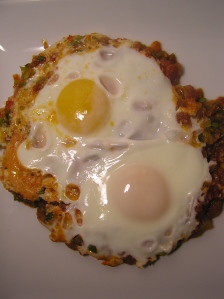
gorgeous polentaJust look at how pretty that is!  This is the Rustic Polenta Integrale from Anson Mills.  Its so nice and coarse, you feel like you’re biting into pieces of corn when you eat it.  I purposely made too much so that I could chill some, turning it into hard polenta, but I think I prefer it soft.


Cooking Rustic Polenta Integrale

Use 1 part polenta to 4-5 parts water.

Bring the water to a simmer in a sacuepan on the stovetop.  Whisk the polenta in all at once, and continue whisking every 30 seconds, or so, for the first 5 minutes, or until you begin to see that the polenta is suspended in the water.  Turn down the heat to low, and continue to cook for about an hour, whisking regularly.  Add a healthy pinch of salt and a pat of butter.  If the polenta seems to be getting too thick, add a trickle of water to thin it out.  Serve immediately, or pour it out into a flat baking dish and refrigerate to make hard polenta.

those chocolate sliversYou see, it’s just that…that…well, doggone.  It just seems a little unfair when you think about it.  But everytime you rip daintily open a bite-sized reeces peanut butter cup, you end up with little chocolate slivers stuck to the paper.  And I feel that the ratio of chocolate lost to chocolate devoured goes up with the bite-sized version.  And I think to myself, If I’m only gettin’ one bite, you can bet your be-hind that I’m not gonna allow those little slivers to go to waste! And that’s when I find myself cleaning every little crevasse of that candy-wrapping with my tongue while I sit in traffic only to look up and see the person in the car next to mine smirking at me.  And I think to myself, I bet you’re a candy-wrapper-licker too.  You’re just a closet candy-wrapper-licker.  And here I am, proud enough to do it in public! And then I begin to lick all the stickiness off my fingers in the most respectable way possible.  Then change lanes.  Quickly.

PA170005Broccoli was one of the first vegetables I would eat as a kid.  T-Bone steaks and broccoli were my birthday dinner of choice most years.  And I have kept the love alive!  I came across this lovely idea on Smitten Kitchen and it’s a winner.  And I’m sorry to just re-do what other people have done, but this slaw was really good, and really worth it!  I changed a few things for my own taste.  Here’s what I did.

Broccoli Slaw
*this slaw is best made about 30 minutes ahead, so that the vegetables begin to soften slightly- don’t worry, they’ll still have plenty of crunch!

  • 1 head raw broccoli, thinly sliced
  • 1/4 red onion, sliced
  • 1/4 cup toasted almonds, lightly chopped
  • 1/4 cup raisins
  • 1/2 cup buttermilk
  • 1/3 cup whole-milk yogurt
  • 2 Tablespoons white wine vinegar
  • 3 Tablespoons extra-virgin olive oil
  • a hefty pinch of salt
  • freshly cracked black pepper

In a small bowl, whisk together the buttermilk, yogurt, vinegar, olive oil, a pinch of salt, and pepper.  In a medium bowl, combine the broccoli, onion, raisins, and another pinch of salt.  Pour about 3/4 of the dressing over the salad and toss with your hands, making sure that everything gets coated equally.  Allow to sit for about 30 minutes.  When you’re ready to serve, toss in the almonds.  Yum.

Let me first start by apologizing for the fact that I don’t have any pictures of the ice cream sandwiches because, well, we ate them!  We ate them fast.  Real fast.  And they were good.  Real good.  I’m sorry.

But I do have this:

PA050038which proves that I did infact have the cookies.  So that’s something right?

So if you want to make ice cream sandwiches, this is what you’ll need to do.  Make these gingersnaps.  Find yourself some ice cream.  (I used coffee, but I really want to try it with that yummy brown-butter ice cream!) Temper the ice cream somewhat to soften it.  Place a scoop of ice cream on one cookie.  Top with the other cookie.  Wrap the whole-dang-thing in a little plastic wrap.  Freeze for a few hours.  Remove from freezer.  Eat.  Moan.  Go back to the freezer and eat another.  Yum.

Gingersnap cookies adapted from The Baker’s Dozen Cookbook
*The only thing I would do differently next time is to add a couple Tablespoons of minced crystallized/candied ginger to the dough.

  • 2-1/2 cups all-purpose flour
  • 1 teaspoon baking soda
  • 1 teaspoon ground ginger
  • 1/2 teaspoon ground cloves
  • 1/2 teaspoon ground allspice
  • 1/4 teaspoon ground white pepper
  • 1/8 teaspoon ground cardamom
  • rounded 1/4 teaspoon kosher salt
  • 2 Tablespoons brewed strong coffee, cooled
  • 1/3 cup unsulfured molasses
  • 1 Tablespoon minced peeled fresh ginger
  • 3/4 cup sugar
  • 12 Tablespoons unsalted butter, softened

In a medium bowl, gently whisk together the flour, baking soda, ginger, cloves, allspice, white pepper, cardamom, and salt.

In a medium glass measuring cup, stir together the coffee, molasses, and fresh ginger.

In the bowl of a standing mixer, using the paddle attachment, cream the butter and sugar on medium speed.  Scrape down the sides of the bowl.  With the mixer running on low, add the flour mixture and the molasses mixture, in three alternate batches, starting with the flour mixture, and ending with the molasses mixture.  Finish the last few stirs by hand.

Chill the dough thoroughly, at least 4 hours, or overnight.

Place the oven rack in the center-most position, and preheat the oven to 350 degrees.  Line two cookie sheets with parchment paper. (The original recipe states that these cookies bake best on parchment paper)

Using a 1-Tablespoon measure, scoop out rough balls of dough, and roll them into balls with the palms of your hands.  Space them two-inches apart on the cookie sheets, 12 balls per sheet.  Using the palm of your hand or the oiled bottom of a drinking glass, flatten the balls to 1/4-inch thick.  (Anyone have a tortilla press?  I bet it would work beautifully!)  Bake the cookies, one sheet at a time, for about *11 minutes.  The centers will remain slightly chewy.  Cool on the cookie sheets for two minutes before removing to a cooling rack.

*If you are using these gingersnaps for ice cream sandwiches, bake them so that they have slightly chewy centers.  If you’re baking them to be eaten as gingersnaps, bake them for two minutes longer (13 minutes).

And while we’re at it, a friend of mine from work has been munching gingersnap-wiches filled with ricotta cheese.  Oh gosh, they’re good.  Since learning that, I’ve also tried panir and fresh farmer’s cheese.  Yum.

House-warming

When we first moved into our new house, we wanted to do something that would really make it ours.  We thought of “cleansing” it with a sage-burning, and a million other ideas.  But what we finally settled on was to make chicken stock.  I think the smell of chicken stock on the stove is one of the most comforting smells around.  You can smell it from every room.  Plus, it really does warm up the house, which was perfect for that mid-winter’s day.

We make chicken stock a few times a year, in big batches, and store it in zip-top, quart-sized bags in the freezer.  That seems to be the perfect “portion” size, no matter what we’re making.  Of course, this recipe doesn’t need to be exact.  Scale it up or down, depending upon the size of your stock pot.  And if you want it to be really chicken-y, use less water and more bones.  I like mine to be somewhere in the middle.  Not too chicken-y, but not too dilute.

For the bones, I usually just go to my local butcher and see what he has.  Chicken backs and wings are great because they have lots of collagen in them, making a nice rich, viscous stock.  But you could also just buy some bones and one whole chicken.  It’s a good idea to get some bones that actually have meat on them too, which is why I favor the wings.

This is what I do…

Chicken Stock

  • 7 pounds chicken bones
  • 3 gallons cold water
  • 2 cups roughly cut onion (each onion into about 8 pieces)
  • 1 cup roughly cut, peeled carrot
  • 1 cup roughly cut celery stalks (use the outer, dark green stalks)
  • 1-1/2 Tablespoons kosher salt
  • 5 black peppercorns
  • 1 bay leaf

Place the bones (and whole chicken, if using) in the bottom of the stockpot.  Add the water and salt.  Place the stockpot over high heat and bring to a simmer, skimming the scum as it rises with a ladle.  Leave as much of the fat as possible when you’re skimming, as the fat itself lends flavor to the stock.  Once most of the scum is gone, add the vegetables, peppercorns, and bay leaf, and simmer gently for 6-8 hours.  Don’t allow the stock to boil, as that will emulsify any remaining impurities into the stock.  Taste the stock, periodically, as it’s cooking to assess the flavor development.  When the stock is ready, use a large ladle to pour it through a fine seive, into a large bowl, pot, or other large storage vessel.  Allow the stock to cool at room temperature for a few hours before placing in the refrigerator to cool completely.  Allow to chill over night.  The fat will rise to the top and solidify, making it easy to skim off and discard.  Use a ladle or large measuring cup to pour the stock into individual bags.  Freeze.

PA070001We had dinner with friends the other night, and as a pre-dinner appetizer, we nibbled on the most wonderful roasted tomatoes on fresh bread.  They were so good that I came home the very next day and made some for myself.  The funny thing is this.  My brother-in-law had given me a very similar recipe a few months ago, telling me that it was just the greatest.  I don’t know where the recipe originated, but I figured that since I’d come across it twice in one season, I’d better hop-to-it, and give it a go.

They are so delicious.  They cook for 3 hours in a very low oven, and just concentrate in flavor.  You could chop them up and toss into pasta, nibble them on toast, chop them for a relish….be creative- they’re wonderful!

Oven Roasted Tomatoes in Olive Oil
*this is a very loose recipe that can be adapted to any size baking dish, and any quantity of tomatoes that you have

  • ripe, red, medium-sized tomatoes
  • extra-virgin, or virgin olive oil
  • a handful of garlic cloves, peeled and sliced or chopped
  • basil stems
  • kosher salt
  • opt’l sugar

Place the oven rack in the center-most position, and preheat your oven to 250 degrees.

Wash the tomatoes and slice them in half through the stem-end.  Make two little cuts around the stem to remove it from each piece.  Place the tomatoes, cut-side up, in a baking dish (you could even use a pie dish if you’re just making a small amount).  Tuck basil stems around the tomatoes, and sprinkle the garlic over all.

Drizzle the tomatoes with lots of olive oil (for a pie-dish you’ll use about 1/2 to 3/4 cup; for my 10×14 dish I used almost 1-3/4cups).  Sprinkle salt liberally over the tomatoes.  If your tomatoes are not too sweet, but very tart, you could also sprinkle a very small amount of sugar over them.

Place the baking dish in the oven and cook for 1 hour.  Remove the baking dish from the oven and, using tongs, flip each tomato over so that the cut-side is down.  Bake for 1 more hour.  Remove the baking dish from the oven and flip tomatoes again so that the cut-side is once again, facing up.  Bake for another hour.

Remove from the oven and allow to cool.  Pack them into a bowl or wide-mouth jar, submerging the tomatoes in the oil as much as possible, and keep refrigerated.  They should last at least a week and a half.  Be sure to enjoy the delicious olive oil as a base for nearly anything!

PA050034PA050044Don’t you just love it when the little something that you’ve just baked turns out every-bit as delicious as you hoped it would?  And every-bit as cute too?  These little plum cakes have been calling to me for years now, and when asked to bring dessert to a friendly little gathering last night, I jumped at the chance to bring these.  Plums, afterall, will be going out of season soon, and I just couldnt let it go another year.

They consist of a regular-ol’ butter cake batter with a plum-half pressed into the center.  The cake batter rises around the plum, cradling it.  If I were to tinker with the recipe next time (because I can’t help tinkering), I might try peeling the plums first (blanching them very quickly in boiling water, and then shocking them in an ice-bath).  This is because, when eating the cake, the plum separated somewhat from the cake itself, as the plum’s skin created a bit of a barrier between the two.  Aside from that though, they were lovely.  Also, I served them lightly warmed and plain, but I’m sure they’d be just great with some lightly-sweetened whipped cream or a small scoop of vanilla ice-cream right on top…

Roasted Plum Cakes adapted from Baking with Julia by Dorie Greenspan
yields 6 little cakes
* the original recipe called for using 8-oz ramekins, but I found the 4-oz ramekins to work just fine

  • 4 Tablespoons unsalted butter, at room temperature
  • 1/3 cups packed light brown sugar
  • 1/4 cup white sugar
  • 1 large egg, lightly whisked just to break up the yolk and white
  • 1/4 teaspoon grated orange zest
  • 1/4 teaspoon vanilla extract
  • 1/2 cup all-purpose flour
  • 3/8 teaspoon baking soda
  • 2 Tablespoons buttermilk
  • 3 small-medium sized ripe plums, halved and pitted
  • 1 Tablespoon melted butter for coating the ramekins

Place an oven rack in the center-most position and turn the oven to 350 degrees.  Coat 6 4-ounce ramekins lightly with the melted butter and set them on a cookie sheet or baking tray.  Set aside.

In the bowl of a standing mixer using the paddle attachement, cream together the 4 Tablespoons butter, 1 Tablespoon of brown sugar, and the white sugar on medium speed until light in color, about 2-3 minutes.  Scrape down the sides of the bowl and mix again for 2 minutes more on medium speed, until the sugar has dissolved into the butter.  Scrape down the sides of the bowl again and add half of the egg.  Turn the mixer to high and beat until the egg is incorporated.  Scrape again, and add the remaining egg, beating on high speed, until it’s incorporated.  Scrape, add the orange zest and vanilla, and mix until incorporated.

In a separate small bowl, gently stir together the flour and baking soda.  With the mixer on low speed, add the flour to the creamed butter mixture and mix for about 15 seconds.  Add the buttermilk and mix for another 15-20 seconds.  Finish the last few stirs by hand.

Divide the batter equally among the 6 ramekins (about 2-1/2 Tablespoons batter each).  Place a plum-half, cut-side-up, in the center of each ramekin, pushing down lightly.  Sprinkle the plums with the remaining brown sugar.

Place the baking sheet containing the filled ramekins in the oven and bake for 20-25 minutes, or until a toothpick instered into the cake comes out clean.

Allow the cakes to cool in their ramekins for about 10 minutes.  To remove them from the ramekins, run a butter knife around the edge of the ramekin.  Using a kitchen towel, hold the ramekin at an angle and genltly work the knife underneath the cake, coaxing it out and onto the plate.  If you’ve made them in advance to be served later, re-heat the cakes in a 375 oven for about 5 minutes.  They will warm-through just enough to release from their ramekins.

Wedding from Traci 313

I always have a song in my head.  And I really mean always. If I’m lucky, it’s a good one, but even the good ones get old when you’ve been singing them for eight hours- know what I mean?  But I love the little life-reminders that I often get from the songs that are stuck in my head…almost in my subconscious.

Lately I’ve been humming, “Always look on the briiight si-ide of life (insert the cute little whistle)”.  And the other day I noticed that I was humming it faster, and faster, and faster, the more stressed I became during a busy Friday night service at the restaurant.  Ironic?  Um, yes.  But it did remind me to chill out a little…

And the one I had in my head this past Saturday: Hakuna Matata… Sometimes I think that someone out there watching over me must be inserting these little tunes in my head.  Chill out Emily!  Everything’s gonna be alright!  This ain’t brain surgery, this is Life! …and then I start to feel real sorry for brain surgeons.

P9250019

While I’m mostly inclined to continue that title phrase by busting out a little Stevie Wonder, I had actually planned to go a different route.

For once in my life I’ve had the sense to make jam on a day that doesn’t register as one of the hottest days of the year.  Well not yet, anyway.  I’m sure the thermometer will soon spike, and I’ll be left to finish my project in a hot, humid, sticky kitchen, without the faintest relief-breeze.

But in the meantime, I’m going to thoroughly enjoy the cool air next to my jam pot.  I really haven’t made much jam this year, which is totally out of character.  In fact the only jam I’ve made is strawberry.  But then I saw the Elephant Heart plums that Blossom Bluff Orchards had on display last Tuesday at the farmer’s market.  And I thought to myself, “I just can’t go a whole year without that plum jam”.  So I bought a flat and got busy.

Elephant Heart plums are my favorite.  Their skins are vaguely grayish-purple with dark speckles, and their flesh is ruby-red.  They are sweet, but with an edge of tartness, and they have an almost raspberry-like brightness to their flavor.  I just love them.  And of course the jam turns a brilliant red that manages to uplift even the dimmest of winter mornings.

Plum Jam To Keep You Cheerful Through the Winter

  • 10 pounds plums (yielded 16 cups pitted and chunked)
  • 5-6 cups sugar
  • 3 pods of cardamom-optional (because I’m a good Norwegian girl)

Place the plums and the 4 cups of the sugar in a large (I used a 10-quart) pot and turn the heat on high.  Stir regularly until the sugar is completely melted and the plums begin to lose their juice.

Bring the fruit and sugar to a boil and skim any foam that rises. Taste for sweetness.  Remember that the jam will taste less sweet once it has cooled.  Add up to 2 more cups sugar if necessary.  Add the cardmom pods.

Continue cooking at the boil, stirring regularly to prevent sticking.  As the jam reduces in volume, you’ll need to turn down the heat- it will continue to boil even over medium-low heat.  Be sure to stir constantly with a rubber spatula, and be VERY CAREFUL around the hot jam-it will splatter somewhat as it boils.  Wear long kitchen gloves or a towel over your hand so the lava-like splatters don’t burn you.  Reduce to the desired viscosity (*do a freezer test to help determine how thick the jam will be once it has cooled).  Ladle into sterilized jars and either freeze or process in a boiling water bath.

*To do a freezer test, place a small plate in the freezer before you begin.  When you reach a point where you think the jam’s viscosity is right, spoon a little jam onto the chilled plate.  The jam will instantly cool, making it easier for you to decide if you’d like it thicker, or not.

Machete

If these were daggers…..

Then these must be machetes…

P9170005…or maybe one of those cool Hattori Hanso swords like The Bride had in Kill Bill…

…and I’d like to take this moment to offer up a ton of overgrown, tough, practically inedible okra….anyone? anyone?…

Older Posts »